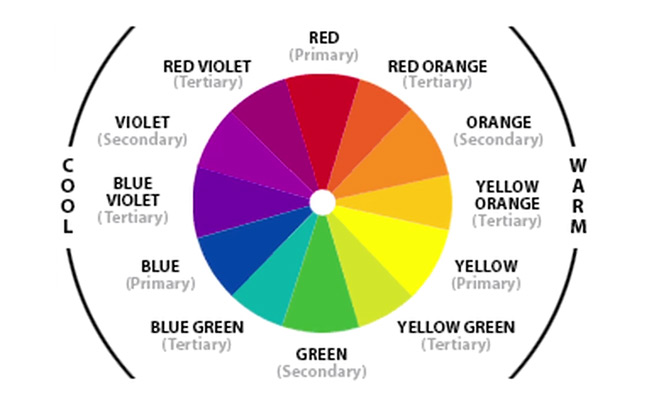
This is the basic color wheel as you can see below each of the colors it says whether there primary, secondary or tertiary.
First of all the terminology:
- Primary Colors: These colors are red, yellow and blue. They are the colors that when mixed they create new colors yet they cannot be created by any other color scheme.
- Secondary Color: Mixing the primary colors together you can produce the secondary colors, these are green, orange and purple.
- Tertiary Colors: These are colors that are created by mixing a primary color with a secondary color to create a new color. It is because of this that the new color has a two- color name such as red-orange, yellow green, red- purple.

- Warm Tones: are colors that are yellow, brown, orange-y reds, peachy pinks and compliment cool tones.
- Cool tone: are green, blue, purple and bluey based reds and pinks and compliment warm tones.

- Complimentary Colors- These are colors that work best with each other for example blue and orange, red and green, purple and yellow .

- Monochromatic Colors: These are all the colors of a single hue containing that colors tints, tones and shade.

- Hue: This is actually more simple to describe then it seems, a hue is any color on the color wheel.
- Tint: A tint is a color that is diluted with an equal amount of white to create more of a pastel color.
- Tones: A tone is a color that has both black and white added to it in equal measure or even a grey. Depending on how much of black and white or grey that was used the color can now appear lighter or darker. They will also be less intense of a color than the original color as it will be more muted.
- Shade: This is when only black is added to the color. This can result in the original color becoming darker and more intense than the original hue. Due to the fact that black paint comes in many different pigments and can sometimes overpower the original hue it is best to maybe use a darker shade other than black or to mix the shades before hand away from the piece so you don't add too much and ruin the overall look of your work.
So hopefully this helped to clear up some confusion that comes with color theory, my college asked us to fill in this worksheet to give us a visual aid that we can carry around with us and refer to when needed. This may be a good idea to have around to refresh your memory every so often.


No comments:
Post a Comment